
Blog / How it works
What to do after a car accident in Jamaica: police report, deadlines and next steps
What to do after a car accident in Jamaica: the emergency numbers, police reporting rules, details to collect and what your insurer will ask for.
8 September 2026 · Updated 27 October 2026
On this page
After a car accident in Jamaica, deal with safety and injuries first, then stop, exchange details, document the scene and report the accident within the required time.
If the driver does not provide the required particulars, section 39 of the Road Traffic Act requires the accident to be reported to a police station or constable as soon as reasonably practicable and within 24 hours. Notify your insurer as soon as possible too, because policy deadlines can apply before you are ready to make a claim.
The next steps may include getting a police accident report, arranging a tow or assessment, finding a body shop, and collecting documents for the insurer. Keep the work in order so you know what to ask at each stage.
Start with safety and emergency help
Stop at the scene when a motor vehicle causes damage or injury to a person, vehicle or animal. Section 39 also requires the driver to provide their name and address, the owner’s name and address, and the vehicle’s identification marks when reasonably required. The Road Traffic Act provisions on accidents set out these duties.
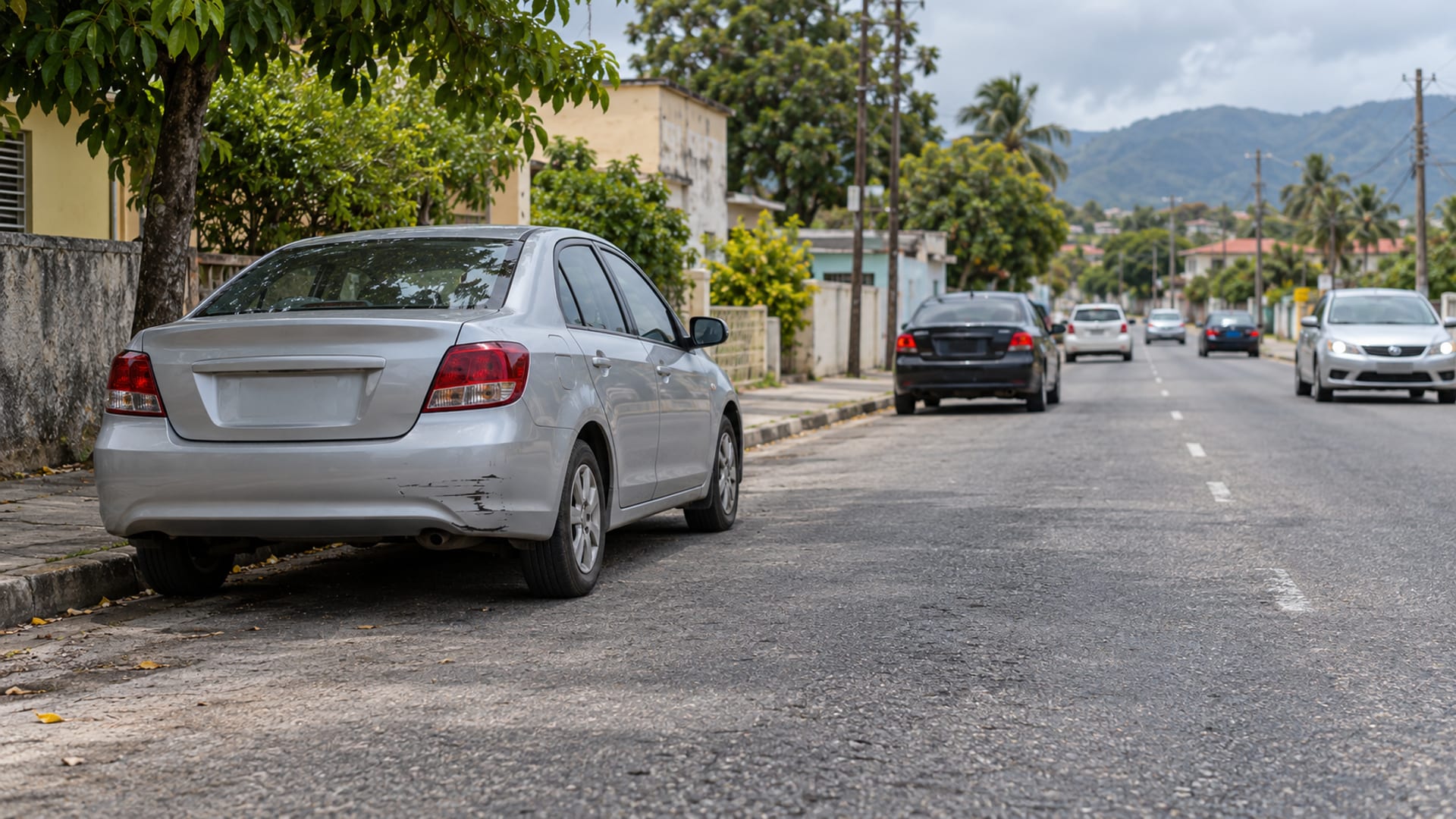
 Check that the scene is safe before you stay there to exchange details.
Check whether anyone is injured and whether the scene is safe enough for you to remain there. If a person is trapped or seriously hurt, call emergency services: 110 for an ambulance and 119 for the police, with 112 for the Jamaica Fire Brigade, as the Jamaica Information Service reported in July 2024. The police number also appears in the JIS personal safety emergency information. If someone is hurt, see what to expect at a public hospital emergency department.
When you call, give the parish, town, road, nearest landmark, callback number, your name and information about injuries or trapped people, as described in the Jamaica Fire Brigade emergency numbers notice.
Avoid unnecessary movement of an injured person unless immediate danger makes movement necessary. Follow police or emergency-service directions about where people and vehicles should remain.
Record the collision details
Once you can do so safely, write down the names and contact information of the drivers, insurance companies and policy numbers. Record each driver’s licence number, licence plate number, vehicle type, colour and model. Note the exact location, including the parish, road, town and a nearby landmark.
Ask witnesses for their names and contact information. Take photographs or videos of the vehicles, their positions, visible damage, road conditions and tyre marks. Keep the original files and note the time if your phone records it.
The Jamaica Constabulary Force advises people involved in a collision to record the attending officer’s name, regulation number and assigned station. Keep those details with the other accident information. Police may need drivers’ licences and documents confirming registration, fitness and insurance. Public passenger and commercial vehicle operators may also need their road licence. The JCF accident-report information sets out the documents and officer details to keep.
Do not put a chassis number or VIN in a public comment or open message. Give those identifying details directly to the police, insurer, parts shop or repair business that needs them.
Report the accident to police within 24 hours when required
If the driver does not provide the required name, address, owner details and vehicle identification information, the accident must be reported to a police station or constable as soon as reasonably practicable and no later than 24 hours after the accident.
The Act’s schedule lists failing to stop after an accident and failing to report an accident as offences carrying six demerit points under the listed provision. The Ministry of Transport states that the Road Traffic Act, 2018 and Road Traffic Regulations, 2022 took effect on February 1, 2023. The Ministry’s Road Traffic Act and Regulations forms provide the current transport-law documents.
Jamaican government accident guidance also directs motorists to report the incident within 24 hours to the police station nearest to their home or the collision site. If the 24-hour period has already passed, report the accident as soon as possible, explain the delay and ask the police division what information and documents it needs.
Get the motor-vehicle accident report
The JCF procedure for obtaining a motor-vehicle accident report follows a set sequence:
- Pay the applicable fee to the Collector of Taxes and keep the receipt.
- Take the receipt to the General Office at the divisional headquarters for the division where the accident occurred and was investigated.
- Complete and sign the prescribed application form.
- Provide the required details and collect the report when notified.
The JCF force order says an abstract report should normally have a maximum two-week turnaround from application to delivery. Before paying, confirm the current fee with Tax Administration Jamaica or the relevant JCF divisional headquarters. Ask which identification documents are needed, where the application should be made, the collection date and who may collect the report.
The JCF force order on accident reports sets out the application route and turnaround. Keep the tax receipt, application details and any notification about collection.
Notify the insurer promptly
Insurance deadlines depend on the policy and insurer. JN General Insurance says an accident should be reported to JNGI, the broker or agent as soon as possible, whether or not you intend to claim, and states that the accident must be reported to the provider within 30 days. Its motor claim requirements include a driver’s licence, vehicle fitness and registration documents, and a repair estimate. The JN General Insurance motor claim instructions explain its reporting channel and document requirements.
 Gather the licence, fitness and registration documents and the repair estimate before you report.
General Accident states that the incident must be reported to the company within 30 days. Its instructions also require police reporting within 24 hours, taking the driver’s licence and vehicle documents to the police, and completing the insurer’s claim form within seven days. Its motor accident claim instructions give the insurer’s process.
Guardian General Jamaica’s accident form gives a 30-day notification period and asks for the driver’s licence, certificate of fitness, registration and completed claim form. Keep the Guardian General accident form with your other paperwork if that is the insurer involved.
A 30-day period should not be treated as a universal deadline for every Jamaican motor policy. Check your policy wording and ask the insurer or broker for the reporting deadline, claim reference, required documents and whether an inspection or police report is needed before repairs begin. Making a car insurance claim in Jamaica goes through the claim stage by stage.
The Financial Services Commission’s motor-claims guidelines say an insurer should respond within five working days after receiving a claim and explain the claims process and required documents. Listed documents include a claim form or letter of claim, repairer’s estimate, statement of how the accident occurred, eyewitness statement, driver’s licence, fitness and registration documents, third-party details, a police report where necessary and a road licence where applicable. The FSC motor-claims guidelines also describe payment after the insured event, liability, payable amount and claimant entitlement have been established.
Decide whether you need a tow or an assessment
If the vehicle cannot remain where it is, contact a tow operator and ask:
- Is a tow available now?
- Does the operator cover the accident location?
- Is there after-hours coverage?
- What is the tow price?
- Is there a call-out or storage charge?
- What does the quoted amount include?
- Where will the vehicle be taken?
- Does the insurer need to authorise the tow or inspection?
- What payment methods are accepted?
Follow police instructions about leaving the vehicle at the scene. Do not arrange a repair before asking the insurer whether it requires an inspection, photographs, an estimate or approval. Tow rates and the questions to put to an operator are in wreckers and towing in Jamaica.
For collision damage, you can contact Body shops and glass and ask whether the business accepts accident vehicles, insurer estimates or third-party claims. Ask whether an appointment is required, what documents are needed, whether the estimate covers parts and labour, and how the business handles additional work found during assessment.
An estimate is not an invoice or an insurance approval. Keep each quote separate and record the vehicle information used, the part description, labour, related work, whether GCT (General Consumption Tax) is included, and the date of the quote.
Prepare for a replacement part or repair quote
If the vehicle needs a replacement part, have the make, model, year, engine information where known, registration details and the part description ready. A make, model and year may not settle fit by themselves. The shop may need a VIN, chassis number, engine code, transmission information, a photograph or the original part number.
 Have the vehicle details ready when you ask a parts shop about a replacement part.
Use the Auto parts shops directory when you need to contact a parts business. Ask whether the part is new, used, remanufactured or aftermarket, and ask for the exact brand or specification. Ask whether the price is for the part only or includes fitting, whether GCT is included, what payment methods apply and what return or exchange terms apply.
For mechanical work, contact Mechanics and repair and describe the vehicle and the work requested without assuming the cause of a noise, smell or warning light. Ask whether the mechanic assesses accident damage, prepares an estimate for an insurer, accepts third-party claims, requires an appointment and separates parts, labour and related work on the quote. How to choose a mechanic in Jamaica lists more questions to ask.
If the accident damaged a tyre or wheel, ask a tyre shop to confirm compatibility using the vehicle maker’s specified size, pressure and load rating. Ask what inspection is included and whether the quoted amount covers the tyre only, fitting, balancing or other work. A tyre category alone does not establish fit.
Compare quotes by matching the scope
Put quotes beside each other only when they cover the same part specification and the same work. For each quote, write down:
- The vehicle details used for the estimate.
- The exact part and brand or specification.
- Whether the part is new, used, aftermarket or remanufactured.
- Parts cost in J$ or JMD.
- Labour cost.
- Related work or materials.
- Whether GCT (General Consumption Tax) is included.
- Inspection or assessment charges.
- The date of the quote.
- The business providing it.
- Payment terms and stated warranty terms.
A parts-only price should not be compared with a fitted price. Ask the business to identify what may change after inspection and to provide the revised amount before extra work begins. If the damage includes paintwork, see car paint job costs in Jamaica.
If the vehicle only needs cleaning after the repair, use the Car washes and detailing directory and ask what the service includes, whether interior cleaning is part of the price, how long the visit may take and which payment methods are accepted. A wash or detailing service does not replace an assessment of collision damage.
When a civil claim or legal advice may be needed
A police report and an insurance claim are different from a civil claim. If there is a dispute about injury, property damage, responsibility, death, a third party or an insurer’s handling of the matter, ask an attorney about the facts and the applicable deadline.
 A police report and an insurance claim are different from a civil claim.
For negligence claims arising from a motor vehicle accident, the Supreme Court has described a general six-year limitation period from when the cause of action arose. The Supreme Court judgment on a motor-vehicle negligence limitation period discusses that period. Different legal bases and circumstances can have different rules, so ask an attorney about the claim before relying on a general time limit. The Limitation of Actions Act is the relevant statute to discuss with legal counsel.
Common questions
How long do I have to report an accident in Jamaica?
If the driver does not provide the required particulars after an accident involving damage or injury, report it to a police station or constable as soon as reasonably practicable and within 24 hours. The JCF also directs motorists to report the incident within 24 hours and to document the scene and exchange information.
What is the first thing you should do immediately after an accident?
Stop and check for injuries. Call emergency services when needed, then document the scene and exchange driver, vehicle and insurance details when it is safe to do so.
What happens if you do not report an accident within 24 hours in Jamaica?
You may fail to comply with section 39 where the required particulars were not provided, and the listed offence carries six demerit points. Report as soon as possible, explain the delay to the police and notify your insurer promptly because the policy may set its own deadline.
How long after an accident can I make a claim?
For insurance, the deadline depends on the policy. JN General Insurance, General Accident and Guardian General Jamaica each publish a 30-day accident-notification period for the relevant motor claim materials, while the FSC guidelines describe payment after a claim has been established, not the first-reporting deadline.
For a civil negligence claim, Jamaican case law describes a general six-year limitation period, but the facts and legal basis can change the result. Ask the insurer, broker or attorney for the deadline that applies to your matter.
For the next call, use the directory of auto parts shops, mechanics, tyre shops and car washes across Jamaica and choose the shop type or parish that matches your errand.